Thursday, April 09, 2009

Was there a distinct style of Jacksonian politics?


The question of whether there was a distinct style of politics in the Jacksonian era of American history, 1820 – 40, is an important one as it is considered that ''Before Jackson, it was possible to think of America without putting the people at the centre of politics; after him, such a thing was inconceivable.'' (Meacham:2008) The distinct style of politics that facilitated this change emerged due to the evolution of party politics and the factionalism that was tearing apart the Republican Party. After 1824 factions broke away from the Republicans to form the Democrat party led by Andrew Jackson. This new faction led to an embryonic form of the two-party system, a transformation in party organisation and an embracing of a new style of political campaigning that disseminated the populist message of Jackson to a electorate that had been radically transformed by the market revolution. This in turn led to Jackson’s political opponents coalescing into the Whig party and in an attempt to recapture the presidency they too embarked on reforms that enabled them to win the 1840 election by embracing the style that had been so successful for the Democrats.

With the decline of the Federalist Party after the War of 1812 we saw national politics evolve in to a one party system. Out of this a consensus emerged that looked to rehabilitate the federalists back into government, what one New England editor at the time coined ''An era of good feelings.'' Though paradoxically what we saw was a growth of factions over the years rather than the harmony James Monroe originally sought (Watson 2006:59). Ultimately this situation led to the various factions within the party producing five candidates for the presidency in 1824 and the subsequent result stands out as it set in motion a chain of events that would be crucial to the development of the two party system. (Ashworth 1995:370)

With the ascendancy of John Quincy Adams to the presidency we immediately saw the splits in the party come to the fore. Jackson had won both the popular and electoral vote but with no overall majority (Pessen 1985:163) the appointment of the president was left to the congress to decide. In congress Henry Clay, frustrated by his low polling figures in the election, still had enough power to as Remini (1997:14) states, play 'king-maker', putting Adams into the presidency while being subsequently offered the office of sectary of state. Allies of Jackson interpreted this deal as a ''corrupt bargain'' and Jackson himself proclaimed that ''The will of the people has been thwarted.'' (1997:14 & 2006:82 )

There where others in Washington who agreed with and shared Jackson's political convictions, most notably Martin Van Buren. Both shared a believe in Jeffersonian Republicanism with Van Buren further believing that the protracted one party system now in operation would lead to corruption and misbehaviour the result of which would be the hobbling of good government. (1997:13) So when, in his first state of the union address, Adams announced the details of a massive spending program called the 'American system' (1997:15) this clique became aghast at the direction the country was taking. As a direct result of this Van Buren reached out to Vice President John C. Calhoun. (1997:16) In a crucial meeting the former impressed on the latter that Jackson was the logical choice to unite behind, due to his popularity with the electorate, in opposition to Adams. (1997:17) Calhoun also shared Jackson and Van Buren's fear of the threat to republicanism and in June of 1826 pledged his support to Jackson for the 1828 election (2006:73) an alliance that was the beginning of the Democrat party.

To get Jackson the presidency in 1828 Van Buren would have to mobilise an electorate that was changing radically due to the processes of the market revolution and an increase in suffrage around the country. These changes in American society where having a profound effect, producing a collective sense of fear for the future of the republic. Americans where losing their faith in the liberty and equality promised by the young country.(Feller 1995:XII) But according to Watson (2006:48) Americans still felt that republicanism could offer them dignity and this did not escape the attention of Van Buren and Jackson.( Rozwenc 1964:XIX) Van Buren knew that Jackson’s achievements combined with his populist majoritarian rhetoric made him the perfect receptacle for the votes of the people but he also recognized that strong party organisation was required and as Watson (2006:87) observes he henceforth set about using the skills and knowledge he gained in New York, where new techniques of mobilizing the electorate had sprung up. (1964:XVII)

To achieve the strong party organisation that Van Buren desired he would go about creating a national structure by adopting the spoils system that he had been in use while he was a Bucktail in New York.(2006:70) This allowed Jackson to distribute patronage and achieve loyalty to the party. (1964:XVII) They also took advantage of new technologies and disseminated their propaganda through a national newspaper based in Washington that would in time expand to encompass many other papers around the country. Their was an embracing of new methods and a reworking of older forms to get across their message such as adopting the symbol of the hickory leaf, they would hold ''Jackson meetings'' in counties that had a Democratic party presence attracting the ire of political opponents who complained that these meeting where comprised of ''..the dissolute, the noisy, the discontented, and designing of society.'' The Democrats replied that these where the real people of America of whom Jackson was one and whose interests he represented.(1997:18-20) They also would hold parades, barbecues, rallies in the hope that they would attract an enthusiastic attentive audience (1985:160) and finally and crucially Van Buren took advantage of the convention.

The convention was crucial as Van Buren recognised the reward that the party could obtain by turning the nomination process over to the voter. In effect it appeared as though the party was decentralizing the appointment process and giving the people an important role in the selection of nominees who would have to vie for the support of the party faithful to gain the nomination. It was also a process that required strong oratory skills, of which Jackson's populist style was suited to. In reality though a study conducted by Richard McCormick during this era showed that they where little more than a cosmetic process that gave the impression of participation but was open to manipulation and control by party leaders and as James Stanton Chase noted ''delegates were only asked to approve a choice made by an inner circle of party leaders.'' (1985:159) Despite the criticism, this new style of campaigning and organising had achieved its goal and the Democrat party held the presidency till 1840.

In response to this the opposition, who had been in disarray for several years, started to coalesces into a faction, the Whigs, that aligned not on what they agreed on but what they opposed, Jackson and his policies.(1995:380) The policies of the Democrats from 1828 onwards had created an environment that solidified the two party system and what we now saw was essentially an alliance of slaveholders and farmers versus those who believed in and where allied with merchant capital.(1995:X) While within the electorate itself, the populist façade of the Democratic party was faltering as government policies over issues such as nullification and the bank crisis revealed where the Democrats agenda lay. This provided an opportunity for the Whigs to expand their base and pick up votes from dismayed Democratic supporters. They did this as the Pessen (1985:169) notes by using the same techniques that the Democrats used in previous elections. They campaigned using populist rhetoric, their candidate in 1840 was, like Jackson, a war hero and on reflection the Democratic Review commenting on the Whigs success concluded ''we have taught them to conquer us!''

In conclusion what we saw in the Jacksonian era was indeed a distinct style of politics. The factionalism that we saw emerge in Washington in the early 1820s led to a radical change in the nature of political campaigns. The reforms we saw here recognised the changing political and social landscape of America, embraced populist majoritarian politics, though a very limited form, then disseminated it through newspapers, rallies, conventions and with the acceptance of these new techniques by opposing political factions we see the formation of a two party system. The legacy of the Jacksonian era and the style of politics that characterised it still reverberate through American society today and we see many parallels to it in modern campaigns where populist politicians try to connect to the electorate through the same ideas of majoritarian politics, using a two party system that has its roots here and in the case of the Obama's 2008 campaign an openness to use new technology to get their message across to the electorate.


Bibliography:
• Ashworth, John. 1995. Slavery, capitalism, and politics in the Antebellum Republic 1 Commerce and compromise, 1820 - 1850. Cambridge [u.a.]: Cambridge Univ. Press.
• Feller, Daniel. 1995. The Jacksonian promise: America, 1815-1840. The American moment. Baltimore, Md: Johns Hopkins University Press.
• Meacham, Jon “The Change Agent. Our politics are rooted in the grand, complicated presidency of Andrew Jackson.” New York. http://www.newsweek.com/id/166828/output/print (accessed March 4, 2009).
• Pessen, Edward. 1985. Jacksonian America: society, personality, and politics. Urbana: University of Illinois Press.
• Remini, Robert Vincent. 1997. The Jacksonian era. Wheeling, Ill: Harlan Davidson.
• Rozwenc, Edwin C. 1964. Ideology and power in the age of Jackson. Garden City, N.Y.: Anchor Books.
• Watson, Harry L. 2006. Liberty and power: the politics of Jacksonian America. New York: Hill and Wang.

Tuesday, December 09, 2008

How and why did the Chinese and Japanese responses to the West differ during the nineteenth century?


The key issue here, how and why the responses differed, is important because it enables us to understand how the continuing process of industrialisation is effected by both internal and external pressures. This matters because the processes of
industrialisation is still ongoing and having a better understanding of the past will lead us into making better decisions in the future. So to answer this question we shall look at the different responses to the West's encroachment into these nations, first the Chinese and then the Japanese, while analysing the social, cultural and political factors that had such a profound effect on the outcomes.

China's initial encounters with the west came as early as 1514, but by this time it was a self sufficient centralized state (Fairbank 1979:151) due to its regional dominance and trade ties created through the Tribute system (1979:160). The legacy of this cultural and regional domination led the Chinese to believe that 'China was the unique land of civilization' (Craig & Reischauer 1978:122). There was nothing that they could learn from the Western barbarians (1978:122). In fact they felt Westerners where no better than the Mongols and they had dealt with them by building the Great Wall of China. With this kind of attitude trade early on with the west was restricted to Canton (1979:162). The Canton System, as it was called, was problematic, but still benefits where enjoyed by all (1979:162). Unfortunately the status quo would not remain. Chinese domestic problems where just starting to emerge and these would have serious repercussions

The main problem in China during this period was the stagnation of the Manchu Dynasty. The subsequent decline of this centralized bureaucracy meant it was unable to respond to a population explosion that saw a two-fold increase from 200 to 400 million between the early and mid 19th century (1979:173). The roots of this phenomena originate in the internal peace brought about by the Manchu dynasty. They took advantage of an increase in foreign trade, improvements in transport and most crucially continued growth in food production to facilitate the necessary factors needed to see a sustained population increase (1979:173). But from this point onwards the Manchu's centralized bureaucracy started to become the problem. Its disconnect from the reality outside Peking meant policy was slow to respond, with one particular problem being that of the tax code (1979:174). The Manchu's inaction in regards to the tax code and the changing demographics had a drastic effect on the public purse. The reduction in government revenue and expenditure expedited the decline of institutions they had been created to maintain social order and stability. Of the many social problems this created the one that is of importance here is the surge in opium addiction.

Opium had a detrimental effect for several reasons. First for the Chinese the illicit trade in opium was not just aggravating current social problems but it was draining the countries capital reserves which led to an exasperation of wider economic problems (Harrison 1967:16). Secondly China's solution, suppression of the trade antagonised relations with western traders and this led to the collapse of the Canton system. By interfering with the trade of the narcotic the Chinese where hurting the British Empire at its weakest point, its capital surplus, and endangering its imperial mission of civilization. The actions taken by Commissioner Lin Tse-Hu, in 1840, to control the trade directly resulted in the two Opium Wars, with the subsequent result being that China capitulated to Western desires and interests in the region.

The Opium wars where an unmitigated disaster for the Chinese. For one thing it it could have been avoided but the decline of the Manchu dynasty had led to a situation where Peking was not receiving the information it required and so formulated policy based on the falsities it received from officials more interested in preserving the status quo (1967:30). In effect as Harrison (1967:31) notes this 'represented the growing degeneration of the financial health of the government and the people.' As a result of these factors the West forced the unequal treaties on china (1967:20). These treaties brought about a legal structure that had evolved by 1858 to a point where the West gained an upper hand against china in its demands for trade on its terms (1979:165).

These demands in general where not favourable to the Chinese but the most destructive was the 'most favoured nation clause.' This clause meant that all foreign powers shared the privileges that they leveraged out of the Chinese (1079:169). This diversion of income further compounded the situation for the Manchu Dynasty as now they had even less capital to halt the decay in the institutions tasked with preventing the social unrest that could lead to a fermenting and mobilising of Chinese society into revolutionary movements (1967:29). The first of which to appear in this period was the Taiping Rebellion.

The Taiping rebellion gained ground because it appealed to the poor and desperate in Chinese society by supporting the ancient right of peasant ownership through their agrarian reforms of 1853(1967:38). Unfortunately its nationalistic rhetoric put it at odds with the west (1967:39) and this was fundamental to its success, or lack of it, as the Imperial powers decided to prop up the Manchu Dynasty. The rebellion though did produce one development that is relevant here. To deal with the unrest Peking had given the provinces more power with the result that once this decentralisation was complete authority had shifted away from the centre to the provinces and the Manchus where never to regain it (1967:43).


This de-centralization led to the final disintegration of the old system but the problems that derived from the last century of decline where too powerful to overcome in the short term. It was not till 1901, after the third of the great shocks, with the restructuring of the Chinese state by the West that industrialization started to begin in earnest. Unfortunately by this time just across the seas the Japanese had emerged from their round of industrialisation to up surd the old order and become the new regional hegemon.

With the arrival of Western powers in Japan the reaction they received was rather similar to the Chinese one, initial isolation but increasing pressure from Western traders resulting in the signing of unequal treaties by the home nation.(1978:120). But unlike the the Chinese, Japanese society contained several factors that meant this position would not have such a prevalent influence. The first was the Japanese attitude to the outside world (1978:122). Where as the Chinese saw themselves as a superior civilization the Japanese, as Reischauer & Craig (1978:122) suggest, where distinct enough to have developed their own identity. One that, while weary of China, recognised a plurality of civilised nations due to the fact that they had learned from other nations. Entertaining the idea that they could learn from the West was not hard for the Japanese to embrace. Secondly as opposed to China's centralized bureaucracy Japanese society was still based on a feudal system unified under a shogun that was fast losing power to the 260 domains scattered throughout the country. This multitude of political systems resulted in a variety of responses to Western encroachment (1978:123) and unlike in China, the central authority here was unable to suppress the agents of change present in Japanese society.

These agents of change took the form of two domains, Satsuma and Choshu. As mentioned in the last paragraph the initial reaction to the West was expulsion and these two where no different. One example of this policy was the Choshu actions, while in the ascendancy in the spring of 1683, forcing the shogun into setting a date for the Westerners to be expelled. (1978:128) The subsequent display of military strength, meant to cast the barbarians out, resulted in military defeat, but it did reveal two factors: the lack of authority that the shogun held and the ineffectiveness of the Japanese defences against the superior military technology of the West (1978: 128-9)

Military defeat of the Choshu by the West, while humiliating, lead them to recognise the futility of their foreign policy but also and more importantly they realised the need to modernize their own military force and techniques (1978: 129) In the same period the Satsuma leaders also realised the same fact (1978:130) and possessing the necessary capital both regions embarked on a process of trade with the West (1978:127) that imported the technology and techniques required to eventually defeat the shogun and bring an end to the Tokugawa system. (1978:131)

With the end of the Tokugawa system Satsuma and Choshu as the two power houses in Japan led what Reischauer & Craig (1978: 134) called in 1868 an ''imperial restoration.'' This resulted in the creation of a new government headed by the Meiji Emperor. For now though it was largely a symbolic institution with power remaining with the samurai who led the revolution (1978:134), who still had a lot of work to do to meat the demands of industrialisation.

Two factors helped the new government go instigate change. To begin with the new administration was free from the attachments of tradition enabling them to institute drastic innovation. More importantly though the past 15 years of interaction with the West had brought many within Japan to realise that they required realistic policies that would help them retain their independence in the face of a foreign threat that was here for good (1978:135).

The new policies that where formulated recognised the need to match western military and economic power, and that to go about it would require a centralisation of authority so that reforms could be enacted (1978:135). The issuing of the ''Five Articles of Oath'' reaffirmed this believe and the direction of the new government (1978:135). The articles called for a establishment of assemblies for public debate, the removal of the old feudal restrictions and finally a call of adherence to the just laws of nature (1978:135).

What this last article meant in reality was that knowledge from around the world would be instrumental in establishing and strengthening the new Japan (1978:136). In effect the new order had moved from its original position of expulsion to that of, as Reischauer & Craig (1978:136) suggest, reinventing the ancient Chinese idea of 'fukoku kyobei' (a rich country and strong military) through western technology. These changes where successful for two reasons; firstly because the factions in charge of government, Choshu and Satsuma, where the strongest domains and they where able to co-opt the rest for fear of being left out of the new state being built (1978:137). Secondly unlike China where the Emperor was seen as part of the old elite system the Japanese emperor was not and this made it a lot easier for power to be handed back to a strong central authority. With a determined administration in place, that now had the requisite authority, the Meiji Restoration set about solving the domestic and foreign policy dilemma that where holding the country back (1978:144). Japan was so successful at this transition that by 1905 they had revised the unequal treaties, invaded China, formed an alliance with Britain and defeated the Russian navy.

In conclusion the evidence presented shows that while both nations where initially inclined to observe isolationist policies when it came to the West, Japanese culture allowed it to recognise the futility of this stance while the Chinese sense of its own superiority blinded it to the strength of Western imperialism. This arrogance along with the centralized bureaucracy of the Manchu Dynasty led to a stagnation of policy meaning that the Chinese administrators could not react to the changes industrialisation was bringing to the country. Meanwhile the feudal system still operating in Japan allowed a fluidity of political alternatives to exist that facilitated a more positive response to Western encroachment. This acceptance of Western technologies and ideas led Japan to not only industrialize faster than China but to become a power that rivalled any nation in the west. Though as we can see from events occurring in the world today it could be argued that China, since the mid 1990's, has re-emerged not just as a regional hegemon but in this time of global economic crisis possibly the one nation that could up surd America as the new global superpower.

Bibliography:
Craig, A. & Reischauer, E., 1978. Japan tradition and transformation. Cambridge (MA): Houghton Mifflin School
Fairbank, J.K., 1979. The United States and China. 4th ed. London: Harvard University Press
Harrison, J. 1967. China since 1800. New York: Brace & World

Sunday, November 30, 2008

Why did colonial Virginians replace servitude with slavery?


The question of why Virginians replaced servitude, the system of locking immigrants from the old world into long contracts of service to pay off their passage, with slavery is an important one to discuss as it gives us an insight into the type of processes that would allow such a morally apprehensible situation to occur and hopefully prevent a similar situation re-occurring in the future. I believe that the primary driver of this process was the development of the tobacco industry and the demographic changes in England of the 17th century. This subsequently caused labour supply problems in Virginia forcing planters to make a long term economic decision, namely to replace indentured servants with slaves. There was other factors such as theology, racism and skill sets but these affected the choice of peoples enslaved, namely West Africans, and worked in combination with the above, as Ira Berlin notes (1998:8), to facilitate a transformation of Virginia from a society with slaves into a slave society by 1705.
After several years of disease, conflict and other hardships the Virginian colony and economy finally stabilised around the mid 1610's with the establishment of tobacco as its main cash crop (Woods 1997:71). At first the settlers recognised that they had two problems to overcome; that of land and labour (1997:72). The first problem, that of land, was easy enough to overcome as they just took what they wanted (1997:72) especially after the 'Massacre of 1622' gave them the necessary justification to expand onto the land of the indigenous population (1997:72). With this out of they way they could turn their attention to the second problem; satisfying the necessary labour requirements of working the tobacco fields.
Initially there was three solutions presented to solve this problem; Indians, Indentured servitude or West Africans (1997:74). First they tried to enslave the indigenous Indians but this proved to be troublesome for two reasons; they would run away and it did not make good business sense to enslave peoples that the colonists where trying to forge trading and commercial links with (1997:75). With the initial experiment with Indians out of the way they turned to the tried and tested English institution of servitude which they developed to suit their own needs (1997:75). This solved the problem and by the mid 1620's servitude was widespread on the plantations of Virginia (1997:76) and the need for slaves was not at this point realised. Unfortunately for the planters indentured servitude contained the seeds of the next problem they would encounter.
To entice people to agree to indentured servitude the colonists had to grant them the one thing they could not achieve back in England, their liberty, mainly through the promise of land grants when they reached the end of their service(1997:76). This meant that the turnover within the labour force was quite high and made the planters reliant on new servants arriving to replace those that had finished their service. Also the high proportion of poor whites from England caused many social problem, from discontented runaway servants (Parent 2003:57) to newly freed servants turning to insurrection such as in the case of Bacons rebellion (Foner 2006:53). These problems resulted from the deteriorating conditions for servants and the finite opportunities available to those newly freed from servitude. When this news reached England the new world did not appear to be as attractive a prospective as it had been in previous years (2003:56). In addition to this changes back in England, namely demographics, also started to hit recruitment to the colonies.
From the 1660s onwards demographics started to have a profound effect on the English economy. Lower birth rates, disease and migration where relieving the pressure on the economy (2003:58). With lower numbers entering the work force there was reduced competition in the 15 – 24 age range, those most likely to venture to the new world, and this was enhanced further with the Great fire of London in 1666 that led to boom within the building sector and the economy as a whole (2003:58-59). The attitude of the elites to the poor subsequently changed and as Parent (2003:59) puts it they where now seen as a natural resource and the key to profit in the newly industrialising economy. This meant for the first time the prospect of staying in England appeared to offer more prospects than emigrating to America. This was reflected in government policy that in 1680 saw the prosecution of merchants involved in the transportation of servants to the colonies and the encouragement of the slave trade from Africa to the colonies (2003:59-60).
The reduction in the numbers of servants made planters look at the economics of the slave trade (2003:60). This became even more crucial in 1681 as the tobacco price fell by 50% meaning that planters had to look to other ways to reduce costs and as Colonel Nicholas Spencer stated in 1683 ''..Blacks can make it cheaper than Whites.'' (2003:60) Fortunately for Virginian planters one factor that had initially made slavery an unattractive economic proposition in Virginia, demand for slaves in the Caribbean and the subsequent inflation of prices due to this, was finally changing. This demand had meant that very few slaves made it to Virginia but with the deterioration of plantations in islands such as Barbados, the dropping of sugar prices, over investment in the slave trade and the Royal Africa Company monopoly we saw an increasing debt crisis from the 1680s onwards (2003:69). With the defaulting of loans from Caribbean planters the slave traders started to consider Virginia and for the first time Virginians now had favourable economic conditions and a supply of slaves that could facilitate the switch from servants to slaves (2003:70). Now while economics and demographics seem to have played a crucial role in this switch there is also the question of how a society that was based around the ideas of freedom from oppression of the old world and liberty could go down this path of enslavement.
Here another line of thought crops up; one that suggests that there was a certain predisposition that the colonist held that led to the choice of West Africans as the peoples enslaved (1997:6). Authors like Wood suggest that this predisposition was a combination of views that the colonist brought with them from the old world. These
views and ideals where a combination of theology, that allowed bondage of those of different religions (1997:10), and previous held racist ideas of West Africans as strangers who were as Foner (2006:50) states ''...savage, pagan and uncivilized'' (Foner 2006:50). This combination of ideals fitted in with the aspirations of planters who increasing saw slavery as an institution that was becoming indispensable to them in preserving their liberty, I.E. profit (1997:8), and so they set forth enshrining these beliefs into law.
In the early days of the colony black’s legal status was rather unambiguous. So planters tried to incorporate their rights over slaves into law and by 1669 had achieved some of their goals, such as the right to do as they pleased with them (1997:89). From here they still had to clarify two things; what rights slaves retained and on what grounds they could appeal for freedom. To achieve this final eradication of black’s rights planters turned to Christian theology. There had been for a long time a link between bondage and those of different religions dating back to the crusades (1997:8). At the same time to prevent slaves using the same theology to convert to Christianity as a way to achieve freedom, the planters codified the link between Christianity and bondage into law putting a stop to this practise (1997:90). While the planters where convinced in their justification of slavery as necessary, they had a vested interest in this institution as it protected their interests, but this was not true of the rest of colonial society. Planters still needed to enlist the support of working class whites to fortify their hold over colonial society.
With the status of blacks now starting to be enshrined in law, based around old world concepts of slavery, they now started to infuse the debate with language of racism in an attempt as Woods (1997:90) puts it to dehumanises Africans. This allowed planters to evolve old ideas of religious hatred through the latter half of the 17th century into one based on race in an attempt to co-opt working class whites into alliances against the slave population (1997:91). While they may not have been totally successful in this operation, the lack of opportunities for poor whites led to them moving to parts of the colonies where advancement was better. This made it easier to bring the small groups of whites left into an arrangement where they became part of policing mechanisms over slaves (1997:90). With this hardening of racist views and solidifying of alliances of whites against blacks the planters finally codified in to law,
in 1705, Virginia's slave laws (1997:92) and the transformation into a slave society was now complete.
While the evidence seems to support the thesis that a complex mix of economics, demographics and racist ideology made the switch from indentured servitude to slavery possible. There are those who suggest that it was purely economics and demographics and not that of race (1997:81). They point to the fact that the experiences of early slaves shows that there was no predisposition to racism. One of the most famous examples is that of Anthony Johnson. Johnson was a slave who arrived in Virginia in 1621 and managed to obtain his freedom and land and was rather successful suggesting that racism and enslavement of West Africans was not conclusively on the cards at his point (1997:81). But as Woods (1997:82) counters, while slavery of West Africans may not have been at this point certain, there was racist overtones present in elite Virginian society. Here she points to Rolfe's references to blacks as 'Negars' as evidence of whites seeing themselves as different to blacks. While Ira Berlin also refutes this argument by pointing to the ambiguity of blacks status in law (Berlin 1998:44) and their initial equality with working class whites within Virginia's economy that allowed them this measure of freedom (1998:33)
In conclusion the switch from indentured servitude to slavery primarily took place due to economic and demographic necessities. But as the evidence show these factors took place within a society that had many other complex factors at work. These factors included ideas imported from England especially in the sphere of theology and previously held racist ideas of West Africans. So while the enslavement of blacks does appear to not have been pre-determined. When it became a viable way for planter elites to fortify their positions and hold over colonial society it certainly did not take them long to revert to racial stereotypes as a means of securing their liberty at the expense of others. Even today the divisions created in this period still reverberate. The zeal that the planter elites went about codifying these notions into law and the schisms they created between whites and blacks, which produced views of the latter as second class people in American society, in this period have had long lasting effects that we saw come to the fore in the recent US election. On many occasions we saw American whites refer to President elect Oboma as an Arab and someone that could not be trusted (BBC 2008) drawing parallels to the views that colonists held of those that where religiously and ethnically different to them in the 17th century.

Bibliography:
BBC, 2008. Obama outlines economic package. [online] (updated 13 Oct 2008)
Available at: http://news.bbc.co.uk/1/hi/world/americas/us_elections_2008/7667772.stm
[Accessed 25 Nov 2008]
Berlin, I., 1998. Many thousand gone: the first two centuries of slavery in North America. Cambridge (MASS), The Belknap Press of Harvard University Press
Foner, E., 2006. Give me liberty: An American history. New York, W.W. Norton
Wood, B., 1997. The origins of American slavery: Freedom and bondage in the English colonies. New York, Hill and Wang
Parent, A., 2003. Foul Means: The Formation of a Slave Society in Virginia, 1660-1740. Chapel Hill, The University of North Carolina Press
Hello, well after a fairly lenghty absence I am finally back and even though I do not have time to add much I have just started university at Sussex studying International Relations and American Studies. So I shall be posting essays I write for these courses at a minimum.

Thursday, September 20, 2007

Yo cheeba has started College this week, so i am a little busy especially as i've go a dubstep night planned for the 1st of November at the ocean rooms Brighton.


I will try to keep this stuff updated but the next few weeks look to be a little hairy.

Wednesday, September 12, 2007

The Shock Doctrine by Naomi Klein

Tuesday, August 21, 2007

Spidercon makes it to Eastern Europe


Well guys i've hit the old comunist countries for some psy trance action, it's fun so stay tuned for more as it comes along

Friday, July 27, 2007

The cultural influence of Michael Jordan and Muhammed Ali: Some Ideas for my new book

- What would the world be like like if MJ or Ali had not existed.
- MJ has had a massive impact on fashion and cultural, especially as he was one of the first black sport stars to start to earn massive amounts of money
- Ali was the first black sports personality that stood up to the white corporate power structure, losing his title due to his refusal to join the US military and fight in Vietnam, as he said ''Charlie ain't ever called me nigger''
The future of the NBA:

Portland Trailblazers and the Seattle Supersonics meet in the NBA Summer League


Las Vegas 15/07/07

The Trailblazers and Supersonics meet for the first time since they took the first two picks in the draft. A match up that in a few short years will see these two transformed from basement dwellers to probably the premier two in the league due to some wise drafting and trading.

Lets start with the Trailblazers after trading up in last years draft they acquired Brandon Roy (rookie of the year) and La Marcus Aldridge (check that) two potential talents at the 2 and 4 spots. At the one they have Jarret Jack, Sergio Rodriguez, two young talents and with the free agent acquisition of Steve Blake, a player who has proved he can run a team, who should be the wise veteran that the team will need in a couple of years when all the young talent around him develops. This years first round pick though was the real coup of the draft offering them the choice of Oden or Durant, the former a Big man with the potential of O'Neil or Duncan and the latter a 2/3 who could have the scoring potential of Bryant or Jordan. In the end they chose Oden and this allowed them to dispense of Randolph thus dumping a player who often caused trouble and acquiring contracts that can be dropped soon freeing up cap money down the line.

Up in Seattle this year they gained the second pick and with it they took Durant allowing a team with ageing talent in Lewis and Allen to immediately transform into a young team with plenty of potential. They also traded Allen to Boston allowing them to acquire Jeff Green with Boston's pick. This allowed them to acquire their future 3 and 4 spot and like Portland the chance to free up cap room in two years when the contracts they acquired from Boston expire, another smart move. Unlike Portland though they do not have as much young potential looking very week at the 1 and 5 spots, but the extra cap room available in two years should help if their young GM can continue to make smart moves.

On to the game itself and it begins with a little disappointment in my hearth as Oden is out having his tonsils removed. I guess we will just have to wait a little longer to see him and Durant in action in the same game. But there is still enough talent on display to make the game a worthwhile fixture as Durant, Green and a whole host of trailblazers with future potential are on display.

From the beginning Portland show that for at least next season they will hold the advantage over their northern neighbours taking a early lead with Sergio Rodriguez running the team from the one and some contributions from the big Brit Joel Freeland. Half time saw Portland go to the locker with a 10 point lead. It wasn't all bad for Seattle though as Green showed his stuff while Durant, getting of to a slow start but still knocking down shots and getting to the line. In the second half Durant finally showed his stuff adjusting to the Portland's defence and along with Green finally managed to tie the game up late in the 4th. Talent wise though, even without Oden, Portland finally proved too strong pulling away once more for the win.

In conclusion Portland showed that as a team they are nearer the complete package than Seattle, but in Durant and Green, my man of the match, they have two huge talents to build around. Pity the Eastern conference, at this rate no team over there will be able to win the championship for about ten years especially with the West's current dominance in the form of San Antonio, Phoenix and Dallas.

Wednesday, July 11, 2007

Antiworld probably the worst festival in the world ever
Well lets begin with the good points:
- it stopped raining late Thursday night
- err that's it...

Now that we got that out of the the way let me tell you a little story of what could be described as a huge fuck up. From the very beginning the festival was a half million over budget with ticket sales hovering around the 4000 mark, for an event that could hold up to 12000 people. According to my source the promoters where aware of this problem more than a month ahead of the festival but decided to push ahead with it anyway.
Thus by the time the punters turned up the line up had been cut in half as a cost cutting measure...hmmm £110 pound a ticket and half the acts gone, a good start. Overall the music was pretty poor with the trance being mainly commercial Israeli acts. As for as the other types of music was concerned nothing stood out either. Now so far the main problems could be put down to my tastes in music which tend to favour hip hop and its ilk, but I do like my squelchy psy-trance and having a little boogie in the sunshine, but there wasn't even much of that.
But lets move on to moment that really gives Antiworld its special place in the world of festivals. At approximately 2 pm on the Sunday the music topped, that's right the festival was cancelled. Apparently the night before the sewage disposal company managed to dump all the shit into the staff canteen, forcing the council to give the promoters 24 hours notice to shut down.
Now this was 24 hours from Sunday afternoon, so you may think why did the music have to stop, the police on site stated that they where not going to stop the event at this point and that the punters where allowed to stay on site till 1pm the next day, but hell why continue when you can pull the plug blaming the sewage disposal company and in the process save some money. How much money. who knows? but my sources revealed to me that this allowed them to get out of paying a 22 grand electricity bill, and other things such as peoples wages, also they cancelled the rest of Sundays acts, saving a bit more money and I imagine the promotion company will declare its self bankrupt so that the punters that wasted their money on this festival wont be getting any kind of compensation.
Now I don't know how much of this was down to inexperience on the part of the promoters but when when acts such as Evil Nine canceled due to his agent advising him that he probably wouldn't get paid it suggests that the promoters knew problems where afoot but carried on regardless.
In hindsight putting on a electronic festival 2 weeks after Glastonbury and 2 weeks before Glade shows a certain amount of arrogance on the part of the promoters especially considering their reputation is built around running a trance night in London, this was a very big step up and I guess their lack of experience showed in the end.

Wednesday, June 06, 2007

I am not a role model....


Charles Barkley one of the greats of the NBA looks like he may step into the US political arena one day combing my two loves basketball and politics follow this link to read what he has to say about poverty, race and so on while below relive a few of more amusing ads he has stared in.


Spoof ad from the TNT team, head to NBA.com for streaming 'inside the NBA' clips

Tuesday, June 05, 2007

Pirates of the Caribean 3:

As this travesety of film come to a complex near you I think it is time to let the good Doctor have his way with it...

Tuesday, May 15, 2007

Why is the US really in Iraq(not final draft) Added a few more things 27 july 07


1)Economic: Oil is sold in dollars, a year before invasion Saddam started to sell oil to UN in Euro's, if this trend carried on around world USA petrodollar system would weaken causing us economy to collapse, this could not be allowed, but the present weakness of the USA is shown by consequent actions of Chavez, Iran etc.

2)Geo-political: Most countries need oil for economic development, US control of Iraqi oil allows USA to have control of potential enemies/allies i.e. China, Japan etc.

3)Domestic: 9/11 created a climate where Bush and co could introduce laws curtailing freedoms and cracking down on what are domestic political opponents1 Since 9/11 Bush and co have attacked the constitution every chance they get.

4)Personal: Bush and cabinet in cahoots with friends from oil industry. Bush direct links to Texan oil, campaign funds, Rice ex oil board member, has oil tanker named after her. Oil companies interests in Iraqi oil motivated by desire to increase bottom line of oil. Invasion of Iraq allowed US to disrupt flow to UN and rest of the world, driving up prices equalling more profit for oil companies.2 Also the big oil companies feared that any subsequent privatisation of Iraqi oil would allow other foreign companies to share in the spoils and they don't want this to happen especially after they saw what happened in Russia during the 90's where they where excluded from the privatisation of state utilities after the fall of communism3

5)Military Industrial Complex: As warned by Eisenhower? This behemoth of US industry is ever present and intertwined in US foreign and domestic policy, and has especially close ties to the Bush administration with ex-chairmen Cheney now Vice-President and still on the payroll of Halibuton, at least early on in the administration, one of the companies doing very well out of the US occupation in Iraq through to logistic operation in controls for the occupying forces.

Current strategy:

At the moments the democrats and republicans are arguing about reducing troop numbers and congress funding, an argument that fundamentally misunderstands the Bush strategy in Iraq; the fact that their strategy is working.

Obviously to most people the amount of violence in Iraq might suggest that the overall strategy is failing. After all on many occasions members of the Bush administration have suggested that their goal is to provide an environment secure enough that the Iraqi government and their security apparatus can take over from the US army.

Unfortunately after 6 years in office the Bush administration the one thing we have learned is that we can not take them on their word. On many occasions they will make statements that have very little to do with reality, in fact from the beginning they have misled the public on their real reasons for the invasion4

My research has lead me to other conclusion;


1)That the threat of a Iraq descending into civil war is a creation of the occupying force, Iraq is a tribal society with a lot of intermarriage between the different religions. The sectarian violence is definitely present but is between opposing group that are operating in only a small percentage of Iraq, places such as Baghdad that have more chance of media coverage, and this coverage especially from western media is restricted to the Green Zone due to the security problems for foreigners, so journalist become reliant from sources such as 'senior US officials' etc. to provide them with copy


2)Therefore the current breakdown of society and decent into civil war is exactly what the coalition forces want mainly because it will allow the break up of the Iraqi state, most probably in to a 3 state system. This was mentioned as far back as November 2003 in the NY Times5,
3)This will allow the US to focus on the most important regions, that of the South where Bassra is located and the Kurdish regions in the south, while withdrawing from the central regions that have less resources but the most sectarian problems.
4)Continuing insecurity in this region allows the insurgents to continue their disruption of the country and its infrastructure. More importantly it allows the disruption of the oil out of the country an important element in pushing up oil company profits. As noted by others the big oil companies have been letting pipelines in their care deteriorate for years because they want to reduce production not increase it.6

Future Strategy:

So where does the USA go now. Obviously from Bush's recent statements they have no intention of reducing troop numbers or adhering to congress call to accept the new funding bills that would require some kind of commitment to withdrawal dates. This suggests that withdrawal will not occur till a new administration is ushered in, so that would mean after January 2009. Comments from US army generals back in 2003 stated that they believed they would be their for 7 years. That would suggest that the pentagon has been under the assumption the withdrawal would be spring 2010, around the time that a newly elected administration would be about ready to commence withdrawal.

Of course by then the USA would of installed army bases in strategic areas of the country. The Kurds will allow them to install bases in the north as they need US protection from any future military adventures by Turkey. While in the south they will probably use the use the ongoing tension with Iran as an excuse to install bases there, this will have the dual role of keeping control of oil resources while reducing the influence of Iranian backed Iraqi groups who would like to

Conclusion:

Iraq is about oil but it is a little bit more complicated than just that. The main reason before the invasion was a concerted effort by the USA to protect its economy from collapse and to stave off any competition from states such as China, Russia and Euro zone states such as France. But there is also a host of other reasons, such as the influence of the Israeli lobby, and of course the propaganda battle that is being waged back in America itself.


Robert fisk:

civil war, break up of country, Iraq is tribal not religious, they are all intermarried, borders are manufactured by foreigners therefore

Reason for war:

'that a superpower has a visceral need to project military strength',
completes an Iron curtain that runs from Greenland in the north to Somalia in the south, and on the other side of it is Pakistan, India, China and Russia
Pakistan has a bomb and many Taliban supporters
India and China are future economic rival that have tested nuclear capacity
Russia has the bomb and crucially natural resources as well as a competitor in the oil rich area of the Caspian (check that)
Is it just about American projection of power?

Le Monde diplomatique July 2007

Al Qaida: the unwanted guests (Syed Saqleem Shahzad):

As suggested above by Fisk the Pakistan and the Taliban where allies is backed up by the peace accord that they signed in summer of 2006 which suitd both parties as it provided monety and arms to the taliban while suppling Pakistan with breathing room to draw up a strategy to counter Al -Qaida infiltration within its tribal belt.

In this article Dr Muhammad Bashar al-Faithi is quoted as suggesting that Bremer dismantled the Iraqi Sunni security apparatus ''...to draw Al-Qaida militants into Iraq, where it is far more easy to kill or capture them than in Waziristan or Afghanistan.''

This has also helped speed up internal divisions between Muslim groups in Iraq as ''Indigenous Islamic resistance groups have reacted uncomfortably the growth of this near-heresy within Al-Qaida...'' referring to the influx of foreign fighters from Afghanistan that adhere to the Takfirist ideology that regards ''bad Muslims as the real enemy''.

Dr Al Faithi also goes on to state ''We welcomed the first wave of al-Qa'ida fighters, but now we are paying the price; everything they are doing now has badly hurt the resistance movement.''

This would suggest that in the US eyes allowing the foreign extremists to enter Iraq has facilitated a number of strategies
To capture this elements easier as suggested above
to hurt the indigenous resistance elements to the extent that their overall opposition strategy to the US invasion would be rendered less effective
thus in some cases such as the Islamic Army in Iraq (IAI) whose ''....goals where so dissimilar [to Al Qaida] that in some circumstances the IAI might be more willing to deal with the US.''

Friday, May 04, 2007

Spiderman 3 / the review


Well after months of hype, it has arrived and I've just seen it. So here we go and hopes are still high, even if it is a Hollywood production it has a lot of potential, a huge array of characters and 40 years of back story. The strength of the first two, was the development of the characters backed up by 5 minutes spells of CGI magic.

As a big spidey fan the idea of brining him to the wide screen at first filled me with horror as visions of that 80's Captain America movie and other assorted horrors. Well that didn't happen and now we're up to number 3. I hope you all remember how we got here cause I ain't going to bring you up to date, nope let get in there.

Right first problem a little like the second it takes an age to the introduction of the new baddies , focusing on Peter and MJ's on off relationship, while this was fleshed out in the second one, here it revisits old ground almost mirroring Stan Lee's habit of weighing the original comic down with excess dialog and teenage angst. In a set of 2 hours movies this is not a good move and stunts the growth of the franchise when it looked like it was moving in a direction that due to Lee's huge back story could of gone on for years.

I also didn't enjoy the way the plot was tied together and I feel that maybe too much was put in here, too many subplots when there was enough strength in the material that one or even two of the villain could be cut out. Remember in the comics all the subplots here where major story lines developed over years and to have the Sandman introduced as Ben Parkers murderer than have all the loose ends tied up over this and three or four others plot strands in two hours seems like too much to me.


In the end the overall excitement of the first two has been let down the story is bogged down by too much going on while nothing is explored and developed apart from Peter/ MJ's relationship which as I mentioned just seems to thread old ground and at the same time denies long standing spidey villains Sandman, Venom and the Green Goblin the chance to shine. In the comics all these characters have had profound effects on Spiderman but here, with exception to the Goblin, they are introduced and dispatched without much fanfare and thats a shame cause venom is a major villain.

Overall I was disappointed but word of a fourth is already spreading so lets hope this franchise can correct its direction for the next episode which should be along in about 2 and half years can't wait.

Playoff update: Warriors take Mavs in 6


The biggest upset in playoff history occured last night as the 8th seeded took down the number 1 Dallas Mavs with special mention to Baron Davis, Matt Barnes and a lot of help from a home crowd that aint seen playoff action since back in the days of Run TMC.

It wasn't just the biggest upset but also a fun series with the Warrior small ball showing the potential that the Phoneix Suns lack, strength at all 5 positions. The Warriors though did come in with a decisive edge that
of their coach just happening to be Don Nelson the Mavs previous coach, a definite psychological advantage.

But to be fare to the Mavs the Warriors were better than 8th seed, possibly as high as 5th in my opinion. The Warriors entered the playoffs with a strech of 9 wins out of 10, while the Mavs spent early April, having clinched homefield advantage, resting key players in anticipation of a long playoff run. One of the ironies of this series, as noted by Steve Kerr on TNT last night, was of a matchup of these two in the final week of the season that would of kept the Warriors out of the post season if they had lost it.

Still the Mavs where the better team and really the blame should fall on the coach and the big stars. Did Avery need to change his line up to match Nelly or should he have stuck with what won him 67 regular season games. Maybe? but remember in 3 competitive regular season games the lost all of them and had their 17 game win streak ended by the bay area crew, so I think trying to second guess Avery here is unfair. It is towards the players that a fair amount of blame should be attached, Howard had a good series but Nowitzki was contained most of the time and no one else apart from Stackhouse stood up when it mattered. With many experts pointing to the strength of the Dallas bench this was a huge disappointment especially when the starters failed to show up.

But for all the failings of the Mavs, the Warriors showed that they are a team to be reckoned with though I doubt they have enough to win a championship this year, mainly because I don't see Davis staying healthy the rest of the way. Without him they lose too much experience and with Nelly threatening to use a 6 man rotation already, major bench issues could be just around the corner.

The positives at the moment though out weight these potential problems. Nelly showed that time off between jobs has not blunted his edge and his adjustments kept Dallas from gaining a foothold every time they threatened. Avery was never able to find a solution to the 5 position with his centers slowing the team down too much when in and the paint too open when they where out. One example of this was Steven Jackson's ability to drive to the rim early in the 4th quarter for easy points as Avery tried to match up without Diop or Dampier in the game.

Another plus was Baron Davis, reacting to the big time by being the only star that earned his big paycheck, keeping the Warriors in games when they looked shakey and fighting through the pain last night when he picked up an early injury in the first. At this crucial point Dallas looked like they could of pushed forward for a big blowout but Davis came back on and even though his ability to reach the rim was severely hampered he still hit some crucial shots. Next up for special attention is Matt Barnes, who was a a game time decision yesterday and in the end moved from the bench to the starting line up. The whole series he showed the kind of hustle that teams need coming of the bench and hopefully next season he can start to be more consistent in a team that looks like it has most of the pieces to challenge seriously in an western conference already loaded with talented teams.

Finally special attention must be given to a homecourt crowd that showed the essential advantage of homefield advantage, and a final advantage that pushed the Warriors over the edge to victory.

Thursday, December 07, 2006

Chavez wins another 6 year term, watch this two clips below to find out why this is important,


Wednesday, December 06, 2006

A Revolutionary tells it like it is.....


...and then strangly enough finds himself and his brothers murdered some time later. Check this video below to see more


Wednesday, November 08, 2006

Websites spotlight 1 (an occasional series of posts that spotlight some of the more usefull sites on the web)

The NBA is back:


Yeah after 3 months of watching classic games from the 80's, the new season is upon us and if your in need of a fix that either isn't supplied by a local network or you don't want to fess up the dollar for some cable type deal let me point you in the direction of a few websites that can help you out:

Davkabt - The original and best site for bittorents
Mixmasters - Not only does it have old and new games mostly available from download servers such as filefront, but also original video mixes and video clips of other sports
Sportbit.org - Another bittorent site that compliments DavkabT
elinksbasket - In an eastern european language but does supply links that can be downloaded through software such as emule and edonkey
NBA.com They have streaming media that is updated daily.

Google Watch & Scroogle: Do you know how much information Google is compiling on you?

Time to bring to your attention a website I found a few weeks ago. Its main purpose is to bring to the public information on Googles's monopolies, policies and data collection. While it may seem minor today within a decade or so google will have databases full of information on any i.p. address that uses it's services and this could have huge implications on civil liberties.

Now, while they have stood up to the US governments demands for access to this information so far, they have not been so dogmatic when it comes to the Chinese. In the case of China they have agreed to all the demands of the authorities so as to achieve their commercial goal of access to the Chinese market. A clear case of business interests before that of their users and possibly of decisions to come.

Even if they do keep this info away from prying governments, the data they have will be very useful, not just for Google but other commercial interests that may decide to take it if they wont hand it over.

Now you may be saying 'what's he on about? Don't this blog belong to google? And yes you would be right. So I have decided that for me the best form of defense is attack. How you may say? Well information is the best way to move forward. Learn where and when you are supplying data to Google.

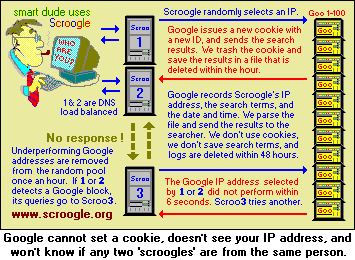
The best place to find this out is Google-watch.org, and use Scroogle

Scroogle

Scroogle is a website and browser extension that basically hides your i.p. address, thus allowing you to use Google as a search engine but without Google recording your search data.


Call me a little paranoid, but if you where to look at my search engine results for the last year plus all the other data that google has collected on me, from clicking through on Google supplied ads and Googlemail, it could be interpreted in many ways depending on the persons political or commercial needs. Now while Google ain't doing anything wrong, at least lawfully, a lot of people who use it's services are not fully aware of the vast amounts of data being collected. While this may not be a problem now, it may become one in the future.

So head over to Google Watch and check out what you can do to keep your data away from prying eyes.

Word

Tuesday, November 07, 2006

Election Day in America or business as usual for the worlds number 1 democracy


Well folks it don't get better than this. It's the mid term elections and the whole world is waiting for the US to wake up smell the coffee and give the Democrats what we and they want, the chance to screw Bush over for the next 2 years and in the process maybe it will make the world a safer place for us and Hillary.

Now I ain't no Clinton fan, I firmly believe that the Democrats and Republicans are just two different faction of the one business party, but anything that puts a stop to this current administration is not a bad thing and in the weeks coming up to tonight, polls have showed that the Democrats could take both Houses. Obviously the lead has dropped as we have get nearer to the midterms but one thing that troubles me is the electronic voting machines, the Republican attempts to wipe voter registration lists and how this may effect the outcome.

like in 2000 & 2004 independent investigators has voiced concern that the Republicans are up to the same dirty tricks that gifted Bush; Florida in 2000 and Ohio in 2004. Some are suggesting that they even have their own secret polls that take this poll tampering into effect. This is a very worrying situation, especially when you consider that these actions by the republicans have the main effect of disenfranchising the votes of the people with the most to lose i.e. the poor and persons of ethnic minorities. Add to this the Democrats general demeanor, i.e. Gore allowing public officials aligned to the Republican party, to hand the presidency to Bush, and you can see the magnitude of this problem. And why are the Democrats not doing anything about this scandal? Well maybe because in Democratic held district's they are up to the same tricks.

Watch this video below to find out more or head to Democracy Now to see their report on this problem